What is foaming in granulation?
Foaming in granulation refers to the occurrence of air bubbles inside the plastic due to some reason, which causes the pellet surface to turn white, become rough, and have holes in the pellet. Also, the presence or absence of foaming causes variation in the size of the pellets.
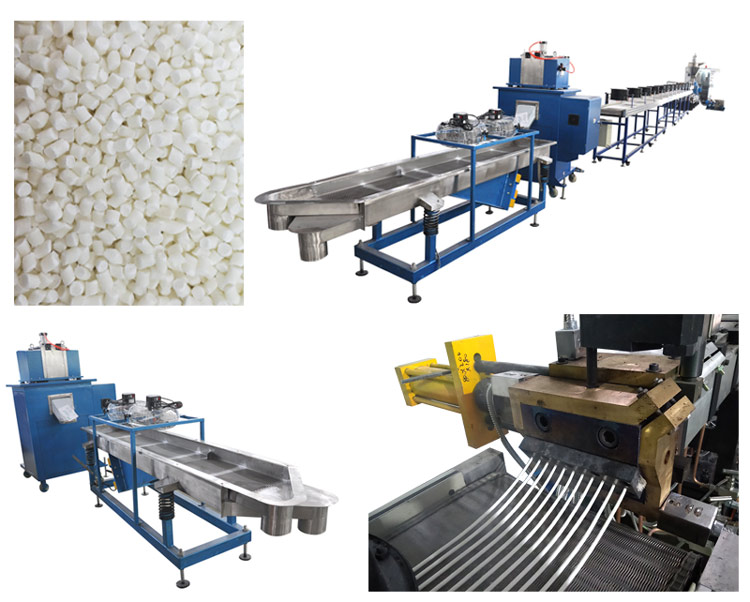
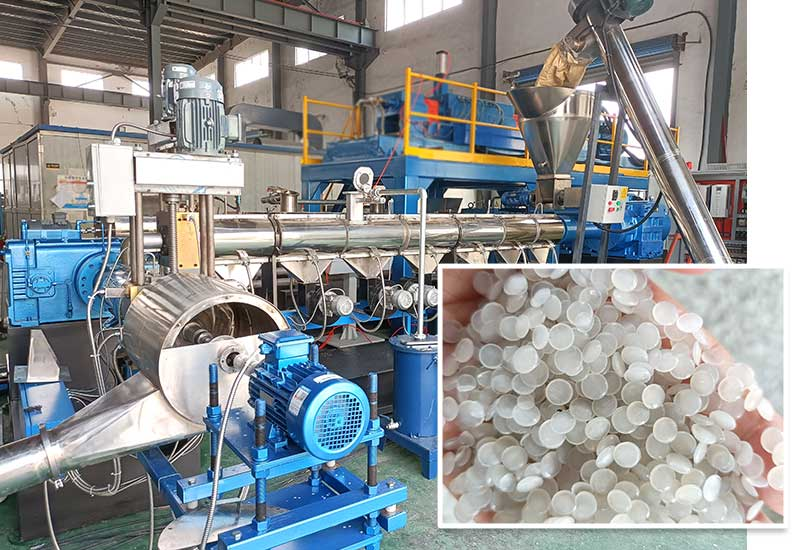
If you look at the photo of foam pellets below, you can see the whitening and roughness mentioned above, as well as the holes and size differences in the pellets.

Foaming not only results in a poor appearance, but also affects the melting speed and other factors due to variations in pellet density, resulting in poor quality of the final product, so care must be taken to prevent foaming.
Causes and countermeasures for foaming during granulation
There are various factors that cause foaming during granulation, including operational issues, storage conditions, and raw material properties.
Air entrapped during granulation
When the raw plastic contains a lot of powder such as crushed powder and there is no vent, bubbles form in the plastic, resulting in a foamed state. This occurs when the plastic melts in the extruder and this air gets sucked in, as there is a lot of air trapped in the gaps between the powder.
Air bubbles often result in poor appearance during molding, but installing vents may solve the problem.
If there is a vent, water vapor and gas can escape from inside the extruder cylinder through the vent, and the air entrained during granulation can also be removed through the vent.
If you want to promote degassing through the vent, using a multi-stage vent like the one below or a vacuum vent that uses a vacuum pump to perform forced air intake will improve the ability to remove air and water vapor from inside the cylinder, making it more difficult for the pellets to foam.

Moisture absorption and evaporation
When using hygroscopic plastics, such as filled materials, foaming may occur if the plastic being granulated is wet.
Hygroscopic materials absorb moisture from the air, so even if there is no visible change, moisture may be stored inside the plastic.
Effective countermeasures include using the plastic immediately after dehydration and drying is complete, re-drying the raw plastic, and installing vent fittings if the extruder is equipped with a vent.
In addition, even plastics with low hygroscopicity may get wet from rain or other factors depending on the storage location, so it is important to store the material in an environment where it can be kept dry.
Decomposition of plastics due to high temperatures
If the set temperature of the extruder melting section is too high above the melting temperature of the plastic, the plastic may decompose and foam.
Plastics derived from extruded products such as films, threads, and pipes have a high viscosity, which means that the shear heat generated inside the cylinder is large and the temperature of the plastic is likely to rise inside the extruder. On the other hand, plastics derived from injection-molded products such as box-shaped and cover-shaped products have a low viscosity to begin with, so the temperature of the plastic is less likely to rise.
When decomposing and foaming, the set temperature of the extruder is often higher than the melting temperature suitable for the plastic, or the temperature of the extruder’s melting section is higher than the set temperature, so adjustments are made to bring it closer to the set temperature by reducing the screw rotation speed, reducing the discharge volume, etc.
Mixed plastic materials
Foaming can occur when plastic material types are mixed, such as when granulating high-viscosity PP without completely removing the PE after granulating high-viscosity PE.
When plastics with different melting temperatures melt, they melt at different times, entraining air and causing foaming, so foaming stops when the plastic material types are completely replaced.
Cooling conditions during pellet formation
There may be a single through hole near the center of the pellet (vacuum bubble). This is because when the strands or pellets coming out of the extruder cool and solidify, they solidify from the outside, causing the shrinkage balance inside and outside the plastic to be lost, resulting in a hole in the center.
In the case of strand-cut pellets, macaroni-shaped holes will appear. Vacuum bubbles are less likely to occur with hot-cut pellets, but a spherical hole may form in the center.
This rarely leads to molding defects, but if you want to improve it, we recommend increasing the cooling water temperature.
Summary
Foaming is a phenomenon in which air bubbles form inside plastic, adversely affecting the appearance and density of pellets.
There are three types of foaming:
- Foaming: A large number of small air bubbles are generated, and the pellet surface often becomes rough.
- Porosity: The bubbles vary in size and are spherical. The pellet surface is less rough.
- Vacuum bubbles: A hole often appears in the center of the pellet.
The causes of foaming and countermeasures for them are as follows:
| Causes of foaming | Countermeasures |
| Air entrained during granulation | Install a vent in the extruder (vacuum vent recommended) |
| Evaporation of moisture from moisture absorption | Raw material drying (improving storage conditions, using a dryer, etc.) |
| Decomposition of plastics due to high temperatures | Setting appropriate temperatures according to the type of plastic |
| Mixing types of plastic materials | Using waste plastic materials to switch material types, etc. |
| Cooling conditions during pellet formation | Increasing the cooling water temperature setting |
Foaming not only looks bad, but it also affects the melting rate, so be sure to deal with it as soon as it occurs.
Q&A
| Question | Answer |
| What are the daily management methods to prevent plastic foaming? | Management of raw plastic: Proper storage environment, prevention of foreign matter contaminationManagement of equipment: Regular inspection and cleaning, check vent functionManagement of manufacturing conditions: Management of temperature, pressure, speed, etc.Quality control: Visual inspection, density measurement, etc. |
| How do you dispose of foamed plastic pellets? | They are often passed through a grinder and fed back into the extruder. Since the thermal history increases, the decision to reuse is made based on whether the physical properties can be secured to meet the specifications of the recycled pellet delivery destination. |
| What kind of plastic is suitable for preventing foaming? | Plastics with low moisture absorption and plastics that are difficult to decompose are suitable. In particular, plastics that have stable performance under high temperature and high humidity environments are preferred. |