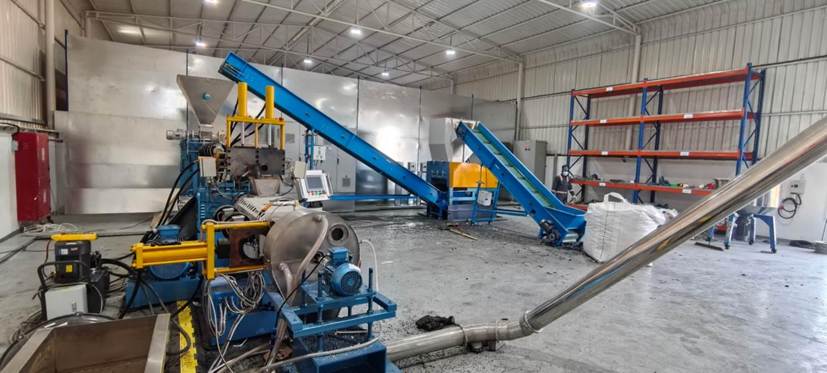
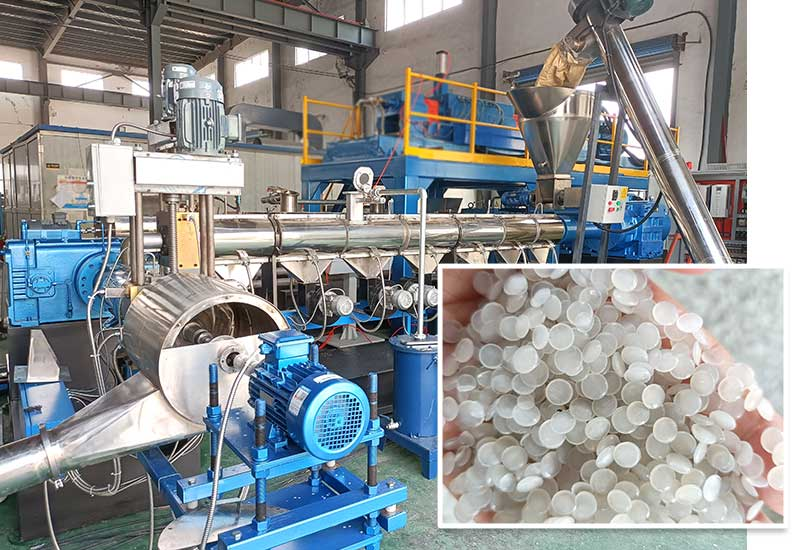
PBAT (Polybutyrate Adipate Terephthalate) is one of the most versatile fully biodegradable polymers in the eco-friendly plastics industry. Due to its soft texture and high elongation at break, PBAT is rarely processed alone; instead, it is typically blended with other biopolymers and inorganic fillers to achieve balanced performance and cost efficiency.
Below is a comprehensive guide on the material properties, typical compounding formulations, downstream applications, and pelletizing methods for PBAT.
1. Key Material Characteristics of PBAT
Understanding PBAT’s inherent physical and chemical behavior is the first step in preparing the material for extrusion and processing:
- High Flexibility & Ductility: PBAT exhibits high elongation at break (often $>500\%$) and exceptional toughness, making its mechanical behavior close to traditional Low-Density Polyethylene (LDPE).
- Thermal & Hydrolytic Sensitivity: PBAT contains ester bonds, making it susceptible to thermal degradation and moisture-induced hydrolysis during elevated processing temperatures (140℃-180℃).
- Good Compostability: It breaks down into water, carbon dioxide, and biomass under standard industrial composting conditions without leaving toxic residues.
- Tackiness in Melt State: Pure PBAT has a low melt strength and a tacky surface when melted, requiring strict control during cooling and pelletizing.

2. Common PBAT Blending Formulations (Compounding Options)
To optimize mechanical strength, barrier properties, degradation rates, and material costs, PBAT is commonly compounded into various multi-component systems:
- PBAT + PLA (Polylactic Acid) Blends:
Purpose: PLA provides high rigidity, tensile strength, and clarity, balancing PBAT’s high flexibility. This is the most widely used baseline blend for commercial bioplastics.
- PBAT + Starch (TPS – Thermoplastic Starch):
Purpose: Thermoplastic starch (modified with plasticizers like glycerol) is blended with PBAT to significantly reduce material costs while accelerating natural biodegradation.
- PBAT + PLA + CaCO3 (Calcium Carbonate Filler):
Purpose: Adding fine inorganic CaCO3 powder improves stiffness, opacity, heat resistance, and further lowers formulation costs for mass-market bags.
- PBAT / PE or PP Hybrid Formulations (Partial Degradation):
Purpose: Used in specific industrial applications where cost reduction is required and total compostability is not mandated by local regulations.

3. Downstream Applications of PBAT Compounds
Once compounded into uniform pellets, PBAT-based materials are processed via film blowing, injection molding, or thermoforming into a wide range of everyday products:
- Flexible Packaging & Films:
Shopping bags, t-shirt bags, and supermarket produce bags.
Agricultural mulch films (eliminating manual film collection from fields).
Express delivery bubble mailers and courier packaging bags.
- Catering & Single-Use Disposables:
Disposable cutlery (forks, knives, spoons), drinking straws, and food containers.
Coated paper cups and food wrapping films.
- Industrial & Agricultural Uses:
Compostable garbage bags, organic waste liners, and binding tapes.

4. Common Pelletizing Methods for PBAT Compounding Lines
Depending on the specific formulation (e.g., pure PBAT vs. high-starch or calcium-filled formulations), selecting the appropriate pelletizing system is essential for smooth pellet production:
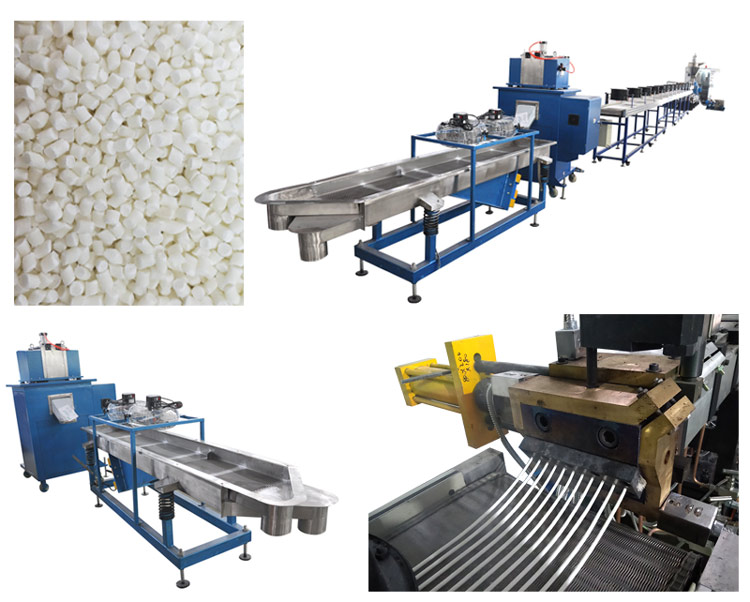
- Air-Cooling Strand Pelletizing (Wind-Cooling Noodle Cutting):
Best For: Formulations that are moisture-sensitive, such as PBAT + Starch (TPS) or high-PLA blends. Strands exit the die, travel along an air-conveyance cooling table, and are cut into dry pellets without water contact.
- Water-Strand Pelletizing (Water Bath Noodle Cutting):
Best For: Rigid formulations with higher PLA or CaCO3 content that possess enough melt strength to pull continuous strands through a cooling water bath.
- Air-Cooling Hot-Cutting (Die-Face Air Cutting):
Best For: Highly tacky, high-PBAT blends or starch-filled blends where pulling continuous strands is difficult. The blades cut pellets directly at the die head, and air streams immediately cool and convey the particles.
Looking for Extrusion Machinery Solutions?
Kairong Machinery provides robust co-rotating twin-screw compounding extruders and auxiliary pelletizing setups (air-cooling strand, water-strand, or die-face air cutting) tailored for PBAT, PLA, and starch compounding lines. Contact our technical team for machinery specifications.