

Country:Egypt
Customer code:117 Country:Egypt Capacity:500-800 kg/h pelletizing system:water ringExtruder:TSH-75 (48) Material:PP/PE
Filler masterbatch production is more than simply mixing mineral powder with a polymer and running it through an extruder. The filler percentage, particle characteristics, carrier resin, feeding behavior, mixing requirements, and pelletizing method all affect how the extrusion line should be configured.
A reliable filler masterbatch line therefore needs to be considered as a complete process, from premixing and feeding to compounding, degassing, and pelletizing. Different formulations may require different combinations of equipment and process configurations.
The following three steps explain how we approach filler masterbatch production and how the main extruder is selected for different formulations and production requirements.
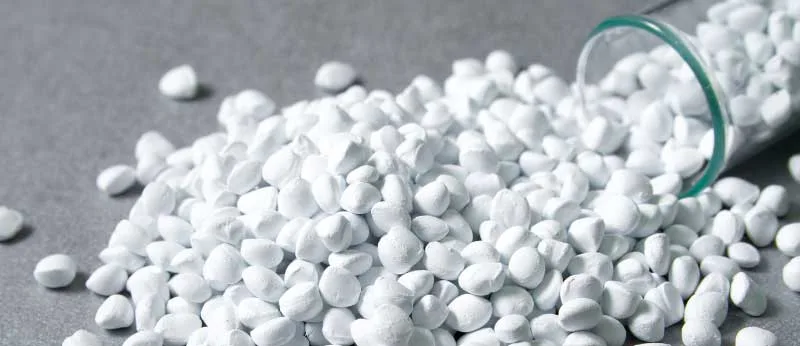
Before the material enters the extruder, the way the mineral powder and polymer are prepared can have a direct impact on feeding stability and the subsequent mixing and dispersion process.
Filler masterbatch formulations commonly use mineral powders such as CaCO₃, talc or other inorganic fillers together with carrier resins such as PE and PP. Depending on the formulation, coupling agents, lubricants and other additives may also be included.
There is no single premixing method that is suitable for every formulation. The choice depends on the filler percentage, powder characteristics, carrier resin and the required production process.
A high-speed mixer is commonly used to prepare mineral-filled masterbatch formulations before extrusion. It can help distribute the mineral powder and additives more uniformly and improve the feeding condition of the premixed material.
For many conventional CaCO₃ filler masterbatch formulations, high-speed mixing is a practical and economical preparation method.
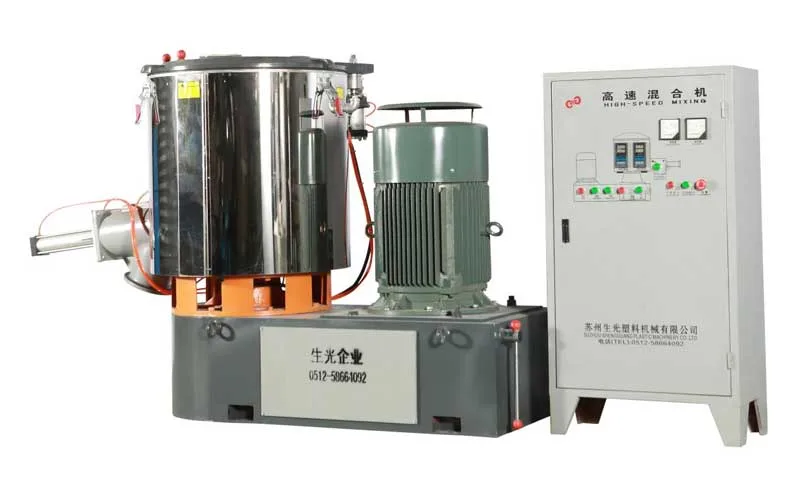

For formulations where temperature during premixing needs to be controlled, a heating and cooling mixer combination can be used. The material can be heated during mixing and then cooled before entering the extrusion process.
For some high-filler or difficult-to-process formulations, more intensive premixing may be considered to improve powder distribution before extrusion.
The appropriate premixing equipment should therefore be selected according to the actual formulation rather than simply according to the filler percentage.
If you are not sure which premixing method is suitable for your filler masterbatch, you can provide us with the filler type, loading ratio, carrier resin and target output. We can evaluate the complete process together with the extrusion system.

The extruder is the core of a filler masterbatch production line. It is responsible not only for melting the carrier resin, but also for incorporating the mineral filler, achieving the required dispersion, removing moisture or volatiles, and delivering a stable melt to the filtration and pelletizing system.
For this reason, the extruder should be selected according to the formulation and production requirements rather than simply by machine size or target output.
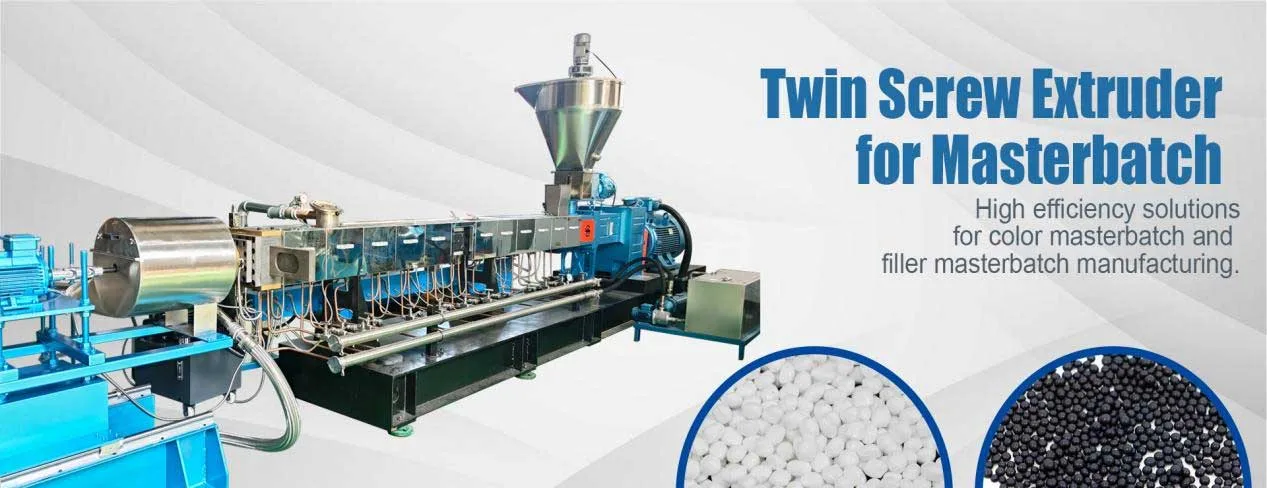
For most filler masterbatch compounding applications, a co-rotating twin screw extruder provides the flexibility needed for high-filler formulations.
Unlike a simple melt-and-convey process, filler masterbatch production requires the mineral powder to be incorporated into the polymer melt and distributed as uniformly as the formulation requires. The twin-screw configuration provides multiple processing zones for feeding, melting, mixing, dispersion, degassing and pressure building.
More importantly, the screw configuration can be adjusted according to the actual material.
Different filler loading ratios, powder characteristics, carrier resins and production requirements may require different combinations of conveying and kneading elements. There is therefore no single “standard” screw arrangement for every CaCO₃ or mineral-filled masterbatch.
Fine mineral powders can behave very differently from polymer pellets. Depending on the powder characteristics and formulation, problems such as poor flow, bridging or unstable feeding may occur.
The feeding system therefore needs to be considered together with the extruder.
Depending on the material, the powder may be introduced through the main feeding system or, where appropriate, through a twin-screw side feeder after the polymer has been partially or fully plasticized.
Side feeding is not required for every filler masterbatch formulation. The appropriate feeding method depends on the material characteristics, formulation and process design.
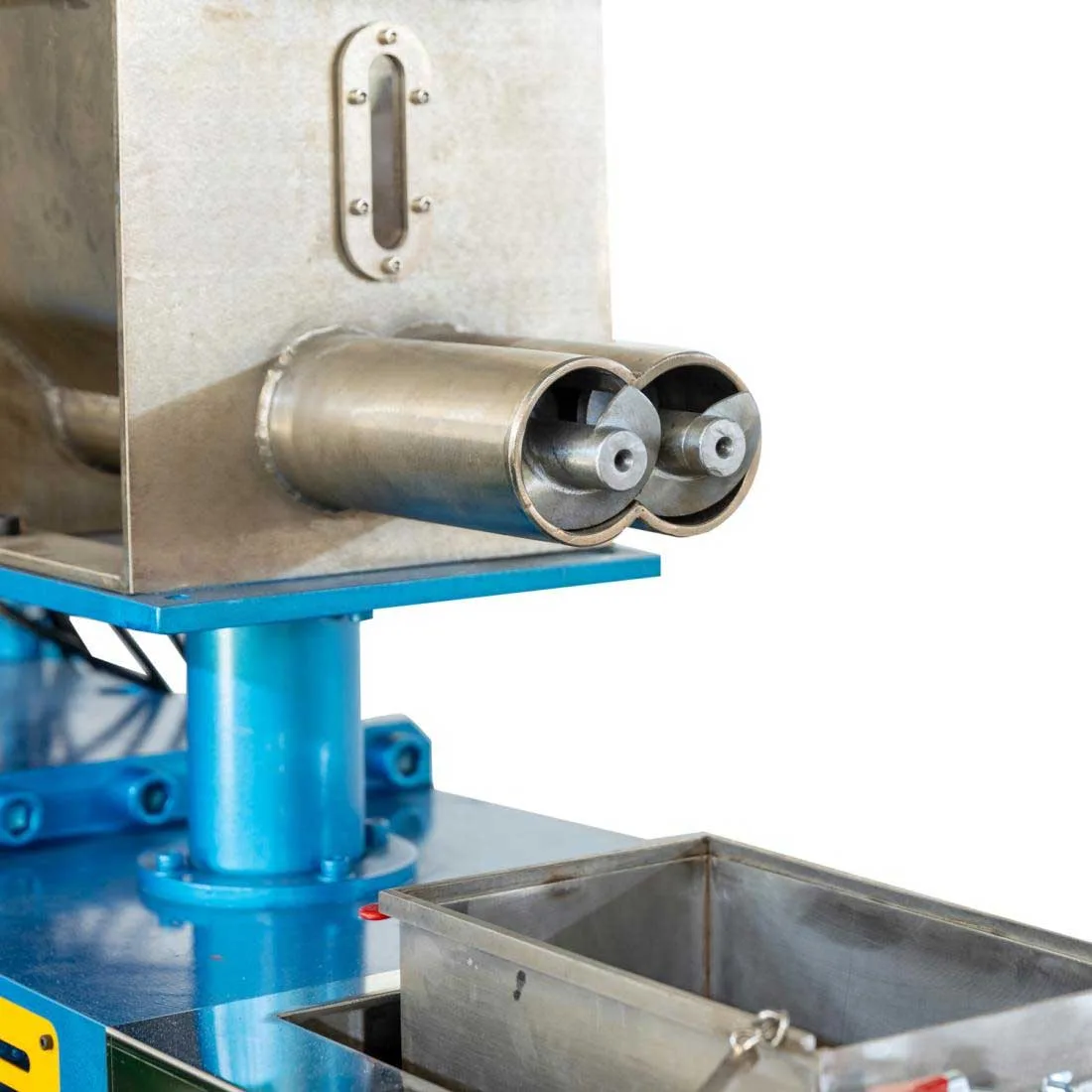
The screw elements determine how the material is conveyed, mixed and subjected to shear inside the extruder.
For high-filler formulations, the objective is not simply to apply as much shear as possible. Excessive shear can increase melt temperature and energy consumption, while insufficient mixing may result in poor filler distribution.
The screw configuration should therefore balance conveying, melting, distributive mixing and dispersive mixing according to the actual formulation.
This is one of the areas where practical extrusion experience becomes important. A machine can have the right diameter and motor power, but still require a different screw configuration for a different material.
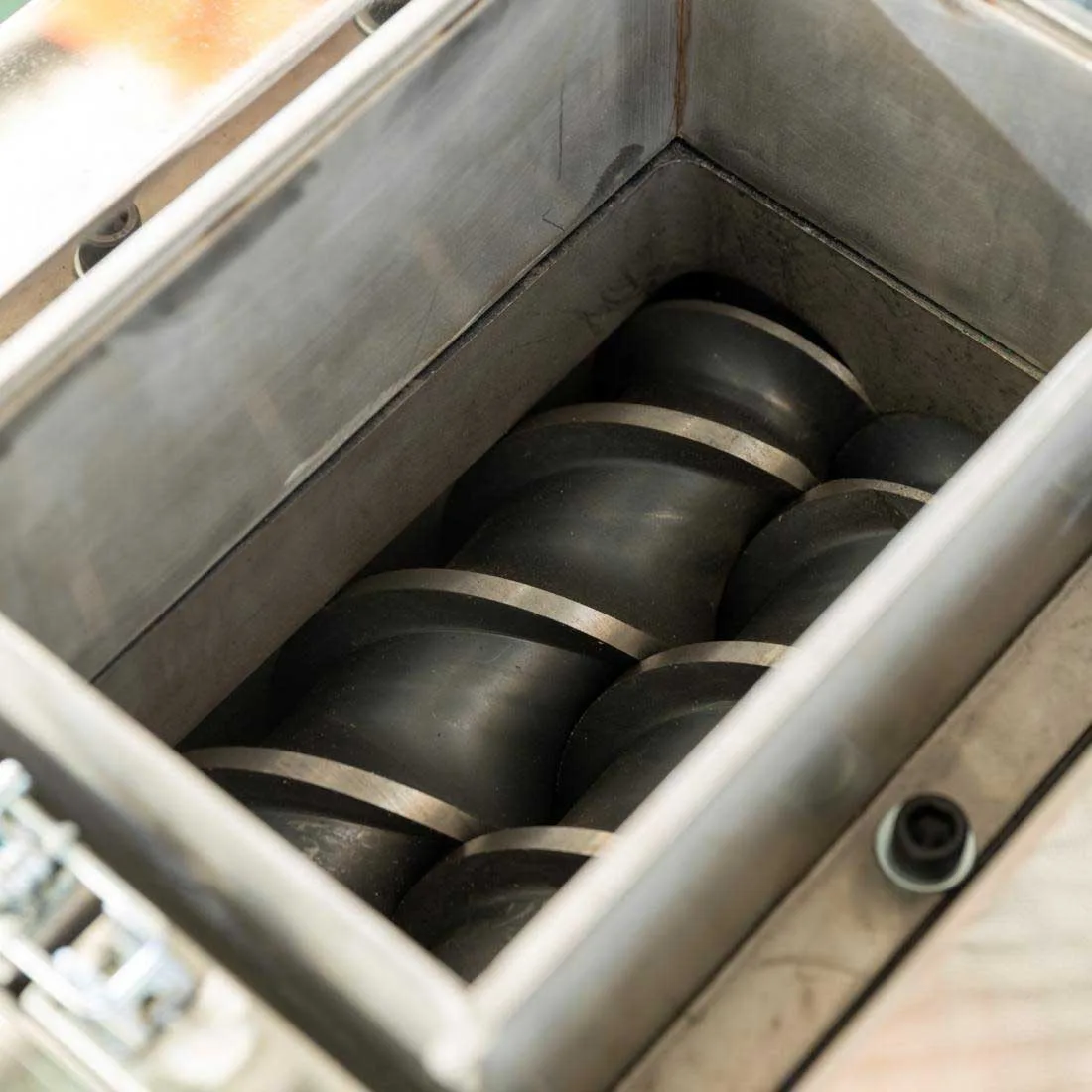
Mineral powders can carry moisture and entrained air into the extrusion process. Recycled or pretreated carrier materials may also contain residual moisture or volatile components.
For this reason, venting and vacuum degassing are often considered in filler masterbatch extrusion.
The position and configuration of the venting section should be determined according to the material condition and the processing stage. If the vent is positioned incorrectly or the melt is not sufficiently stabilized before reaching the vacuum section, material can be carried into the vent and cause vent flooding.
A properly designed degassing section helps remove unwanted air, moisture and volatiles before the melt enters the pressure-building section.

Mineral fillers such as CaCO₃ and talc are abrasive, particularly at high filler percentage. Continuous processing can therefore place significant wear on screw elements and barrel surfaces.
For applications with higher abrasive loading, wear-resistant materials and appropriate barrel protection can be selected for the high-wear processing sections.
Kairong manufactures key twin-screw components and has long-term experience with wear considerations in filled and modified plastics processing. The material and construction of the screw elements and barrel can be selected according to the filler characteristics, loading level and expected production conditions.

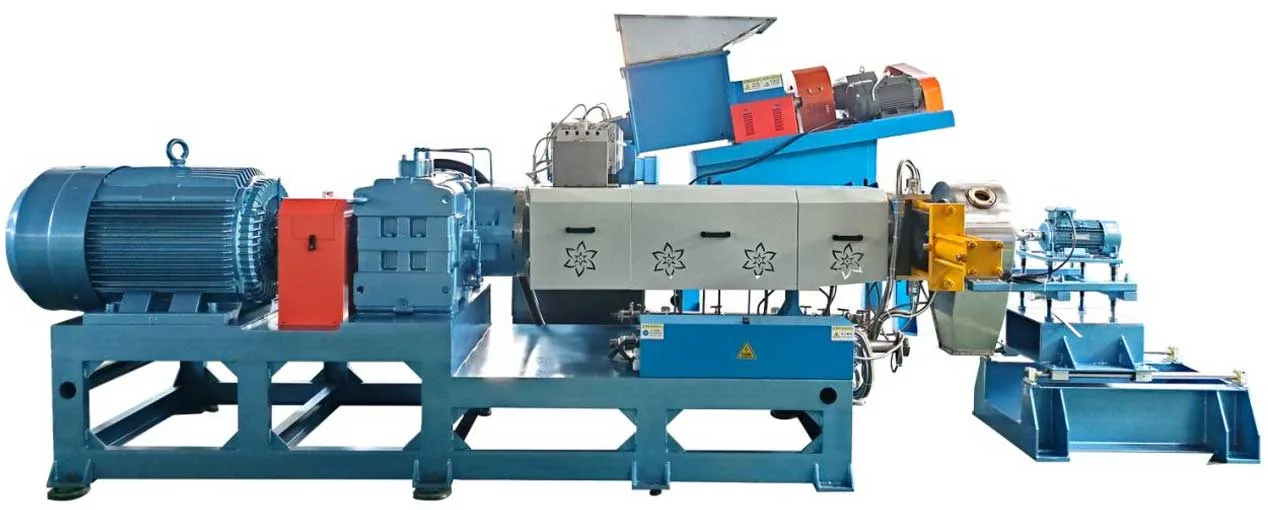
(This two-stage extruder system is paired with a specialized high-speed mixer. The compounded material is discharged in a dough-like state and fed into the extruder via a conical force side feeder. Designed specifically for high-output production, this configuration doubles the capacity of the previous setup.)
A two-stage or tandem extrusion system is not simply a larger version of a twin-screw extruder.
It separates the main processing functions into two extrusion stages.
The first stage can focus on feeding, melting, mixing and degassing, while the second stage receives the prepared melt and focuses on controlled melt conveying, pressure building, filtration and pelletizing.
This configuration can be useful for certain high-filler formulations where temperature control, degassing and stable downstream pressure are particularly important.
It may also be considered when the material requires intensive processing in the first stage but more gentle melt handling after the formulation has been fully plasticized and mixed.
However, a tandem system is not automatically better than a single twin-screw extruder. It adds equipment, space and investment, so it should be selected when the process actually benefits from separating these functions.
For many conventional filler masterbatch formulations, a well-configured twin-screw extruder is sufficient. For more demanding formulations, a tandem system may provide additional process control.
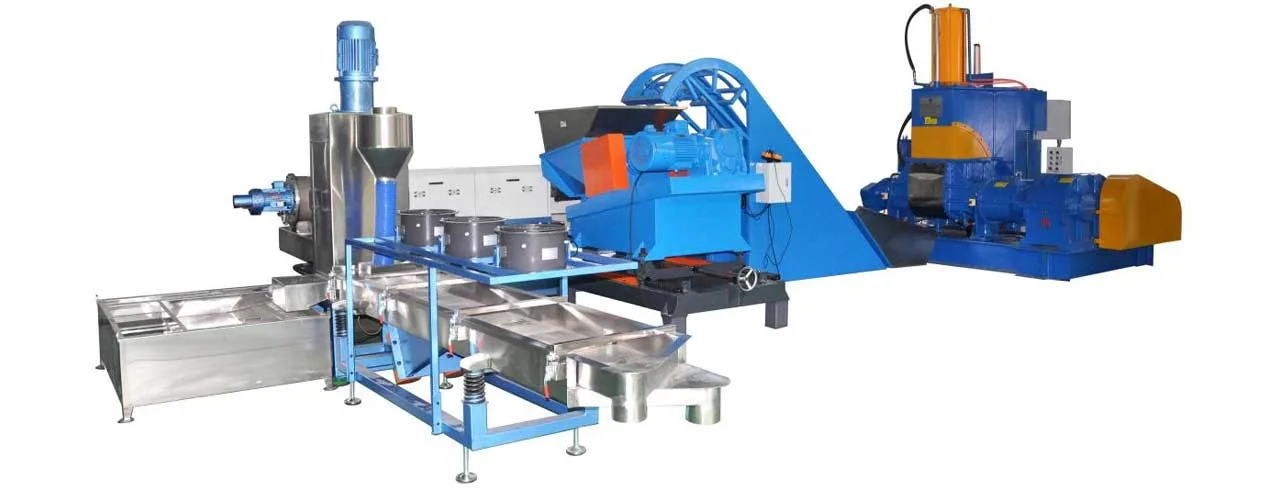
(This single screw extruder is paired with a kneading pre-mixing system for thorough material blending, combined with a new type vertical water-ring pelletizing system. Designed for customers who prefer single screw extrusion.)
Single screw extrusion also has its place in filler masterbatch production, particularly when the material has already been well compounded or when the process does not require intensive mixing and dispersion inside the extruder.
For example, a heavy-duty single screw extruder may be considered for re-melting and pelletizing pre-compounded material.
For formulations where a large amount of mineral powder must be incorporated and dispersed directly during extrusion, however, the process requirements are different. In such cases, the greater mixing flexibility of a twin-screw extruder can be advantageous.
The important point is not to choose a machine simply because it is a single screw or twin screw. The machine should match what actually needs to happen inside the extrusion process.
There is no universal extruder configuration for filler masterbatch.
A practical extrusion system may need to consider:

These factors are interconnected. Changing the filler, carrier resin or filler percentage can change the requirements for feeding, screw configuration, degassing and downstream processing.
This is why we do not simply select a standard extruder model from a catalog and apply the same configuration to every filler masterbatch project.
Kairong has been manufacturing twin-screw extrusion equipment for many years. Our technical team works with the actual material and process requirements to determine the appropriate machine configuration, screw arrangement, feeding system, venting and wear protection.
The goal is not to provide the most complicated machine. It is to build a stable extrusion system that fits the formulation and production requirements.
After compounding, the molten masterbatch must be cooled and cut into stable, uniform pellets. The most suitable pelletizing system depends largely on the filler content, base resin, melt behavior, and the customer’s production requirements.
For filler masterbatch, there is no single pelletizing method that fits every formulation.

(Spain customer’s TSE-75 twin screw extruder for both filler masterbatch and color masterbatch, with basic water-strand pelletizing system and PLC touchscreen control.)
When the filler loading is relatively low, typically below around 40%, water-cooled strand pelletizing is often the most economical solution.
The extruded strands are cooled in water, then conveyed to the strand cutter for pelletizing. The system is relatively simple, easy to operate, and suitable for many conventional compounding formulations.
For lower-filled materials where the melt has sufficient strength to form stable strands, this can be a practical choice when the priority is keeping the pelletizing system simple and cost-effective.
However, as filler loading increases, the melt and strand behavior can change significantly. This is one reason why high-filled masterbatch projects often move toward other pelletizing methods.

(Egypt customer’s TSE-75D twin screw extruder, equipped with kneading system and water-ring pelletizing system, for high-output production of high filling masterbatch and carbon black masterbatch.)

(Egypt customer’s TSE-95D twin screw extruder with air-cooled die-face pelletizing system, achieving over 80% filler loading and output up to 2 tons/h.)
High filler loading is common in filler masterbatch production, so air-cooled die-face and water-ring pelletizing systems are among the configurations we supply most frequently for this application.
Instead of pulling long strands through a cooling bath, the molten material is cut directly at or close to the die face and cooled during the pelletizing process. This provides a more compact process and avoids the need to handle long, heavily filled strands.
The appropriate configuration depends strongly on the base resin.
PP, PE, PE/PP blends, and other resin systems can behave differently during extrusion and cooling. Melt strength, viscosity, cooling behavior, filler loading, and the desired pellet characteristics all affect the choice of pelletizing system.
Therefore, we do not select the pelletizer simply based on the percentage of filler. The resin system and actual processing behavior also need to be considered.

(Egypt customer’s TSE-52 twin screw extruder with underwater pelletizing system, producing both color masterbatch and filler masterbatch. High particle quality requirements, resulting in uniform and well-formed pellets.)
Underwater pelletizing can also be used for filler masterbatch and is selected by some customers with higher requirements for pellet shape, production stability, automation, or overall system configuration.
It is not necessarily required for conventional filler masterbatch production. Compared with strand or die-face pelletizing systems, it generally involves a more sophisticated and higher-investment process.
For this reason, the choice should be based on the customer’s actual production requirements rather than assuming that a more advanced pelletizing system is always necessary.
The choice should be based on the customer’s actual production requirements rather than assuming that a more advanced pelletizing system is always necessary.

Choosing an extruder for filler masterbatch is not simply a matter of matching the target output to a standard machine size.
A 500 kg/h target, for example, does not automatically mean that every 500 kg/h project should use the same extruder. The actual throughput depends on the formulation, feeding behavior, screw configuration, and processing requirements.
We therefore size the extrusion system around the actual formulation and production target, rather than selecting a machine based on output alone.
The requested output gives us the starting point, but it does not define the machine by itself.
For the same extruder diameter, actual throughput can vary significantly between different formulations. A relatively easy-to-process PE or PP formulation with moderate filler loading may run very differently from a highly filled formulation containing a large amount of fine mineral powder.
The feeding system and screw configuration are particularly important. The extruder must not only convey enough material, but also provide sufficient melting, mixing, dispersion, and degassing capacity at the required output.
This is why we consider the following factors together when selecting an extruder:

For relatively small or medium production requirements, a smaller twin-screw extruder may be more practical than simply selecting a larger machine with excess capacity.
For example, when the target output is around 500 kg/h, the appropriate machine size depends on the formulation and the required processing conditions. In some applications, a compact high-torque configuration with an appropriate motor and screw design may provide the required throughput without unnecessarily increasing the machine size.
For larger production requirements, the question is not always whether to move directly to a much larger extruder. Multiple medium-size extrusion lines can sometimes provide a more flexible production solution.
For example, a project requiring approximately 1.5–2.0 tons/h may be evaluated as either a larger single line or multiple smaller lines, depending on the customer’s production schedule, product range, investment plan, and requirements for production flexibility.
The right choice is therefore not simply the machine with the highest nominal capacity. It is the configuration that provides the required output while remaining suitable for the actual formulation and production conditions.
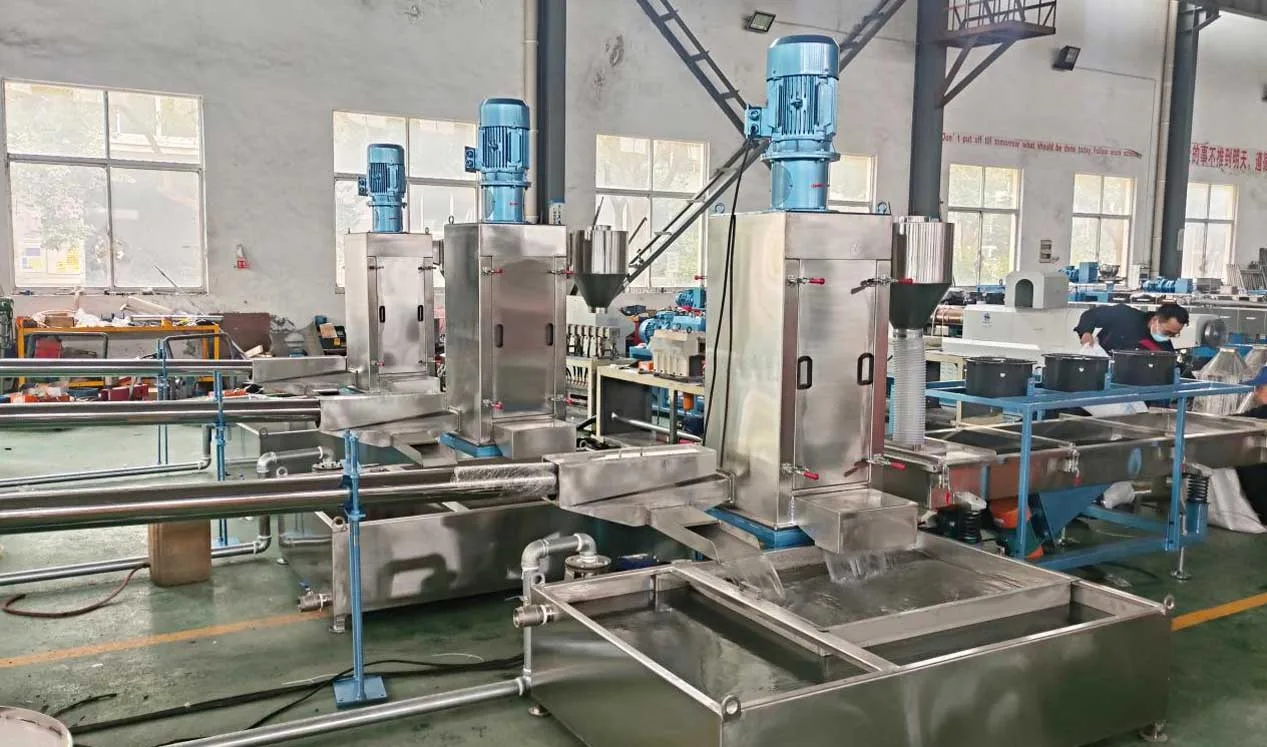
(Three extrusion lines with the same configuration, easy to operate, with stable output and simple maintenance.)
Filler masterbatch producers may manufacture several formulations using different carrier resins and filler loadings. A machine that performs well for one formulation may not have exactly the same practical capacity for another.
This is why we recommend evaluating the formulation + target output + process requirements together.
If the customer provides the filler loading, filler type and mesh size, carrier resin, target output, and any existing production information, we can evaluate the appropriate extruder size, feeding system, screw configuration, drive specification, and pelletizing method as a complete system.

(A US university customer — one extruder with two pelletizing methods, suitable for various formulations. This lab-scale machine is used for teaching and R&D.)
If you are planning a filler masterbatch project, send us:
If you already have a target budget, you can also share it with us so we can consider the appropriate equipment configuration.
Customer code:117 Country:Egypt Capacity:500-800 kg/h pelletizing system:water ringExtruder:TSH-75 (48) Material:PP/PE
Send us email or fill in below contact form. We will reply your message as soon as possible.