If PVC products are soaked in water, exposed to the sun outdoors, or bent or stretched, they will whiten and lose their transparency. Let’s analyze the three major bleaching problems of PVC stabilizer: water immersion bleaching, exposure bleaching and stress bleaching.

1. Water immersion bleaching
Many types of transparent PVC products take on a whitish, hazy appearance when in contact with water or water vapor for extended periods of time. Soft products are more powerful than hard products.
It is believed that this phenomenon is caused by the presence of additives or additive decomposition products that are prone to hydration in the formula. If we only analyze the PVC stabilizer, it is due to the penetration of water that the stabilizer precipitates from the PVC and hydrates, forming hydrated precipitates on the surface (affecting transparency).
In this case, even if the soaked water is gone, the stabilizer cannot return to its original state. Only by raising the temperature to restore the compatibility of the stabilizer can it become transparent.
In this case, even if the soaked water is gone, the stabilizer cannot return to its original state. Only by raising the temperature to restore the compatibility of the stabilizer can it become transparent.
2. Exposure bleaching
PVC products will also appear bleaching when exposed to the sun outdoors.
This is related to the compatibility of PVC stabilizer. Among metal soap PVC stabilizers, benzoate, which has good compatibility with PVC, has less whitening than stearate.
Organotin stabilizers are not prone to whitening, and sulfur-containing organotins are the best, followed by laurate and maleate. Adding light stabilizers, phosphites, liquid composite stabilizers, etc. can prevent or alleviate the whitening phenomenon of PVC caused by exposure to a certain extent.
3. Stress whitening
Stress whitening refers to the whitening phenomenon of PVC hard products in parts of PVC products such as bending creases and stretched parts after being subjected to mechanical external forces, such as bending and stretching. This may be due to the change in molecular structure caused by external force, the orientation of the polymer molecular chain, and the change in PVC density. At the same time, gaps appear between some molecules, forming light scattering, which makes PVC products appear white.

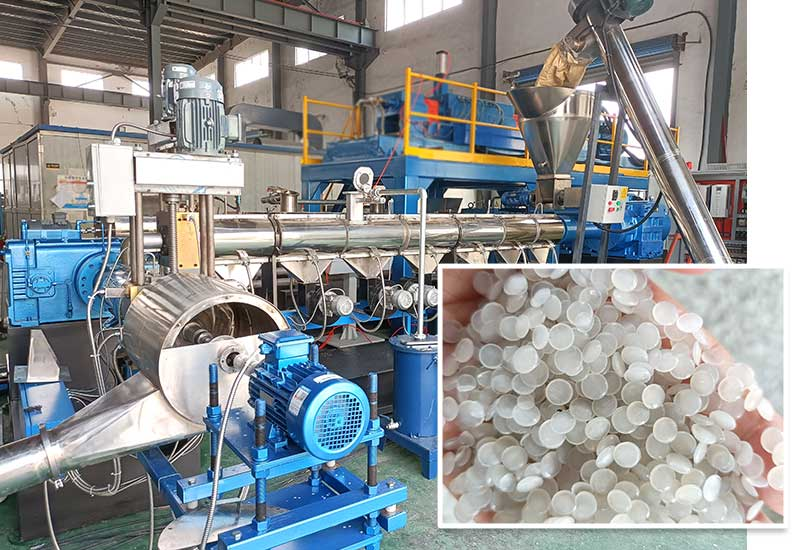
PVC Conical Twin Screw Extruder
Some experts believe that adding high surface energy PVC stabilizers to fill the gaps caused by molecular chain orientation is effective. The use of organotin stabilizers can reduce the whitening phenomenon, especially when combined with organotin maleate, the effect is better.