
Tandem Extruder System
Two-Stage (Tandem) Extruder System
The Two-Stage Extrusion System (Twin Screw + Single Screw Tandem Line) is specifically engineered for thermal-sensitive materials and high-loading compounding applications, such as PVC cable/medical compounds and high-percentage CaCO3/Talc filler masterbatches (up to 70-80%).
By separating the compounding process from the pressurizing and cooling process, this system completely eliminates material degradation and scorching caused by excessive shear heat, delivering superior pellet density and color stability.
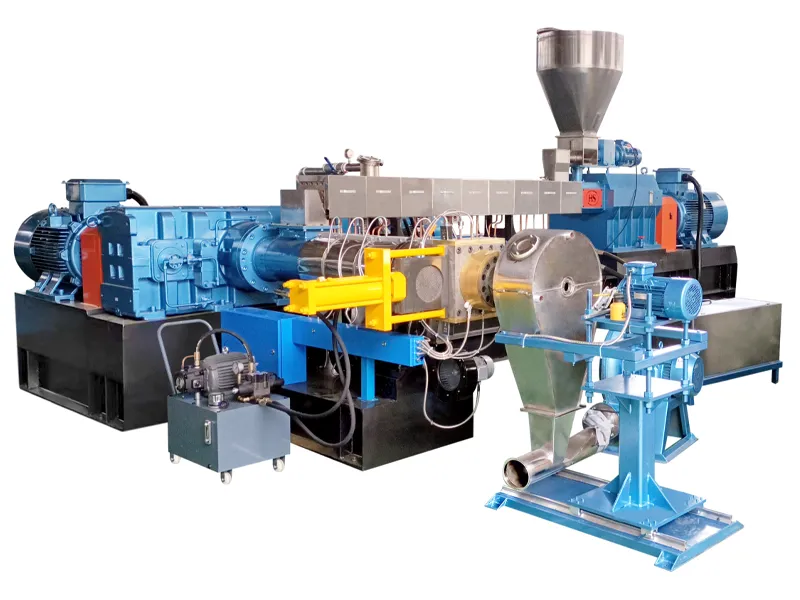
How the Two-Stage System Works:
Stage 1: High-Speed Co-Rotating Twin Screw Extruder (Compounding & Dispersion)
Operates at high RPM to ensure rapid melting, intense shear mixing, and perfect dispersion of high-concentration powders, additives, or PVC stabilizers.
Stage 2: Large-Diameter Low-Speed Single Screw Extruder (Cooling & Extrusion)
Receives the uniform melt from Stage 1. Operating at low RPM with a large barrel surface area, it provides powerful thermal exchange to cool down the melt without over-shearing, smoothly building pressure for pelletizing without scorching.
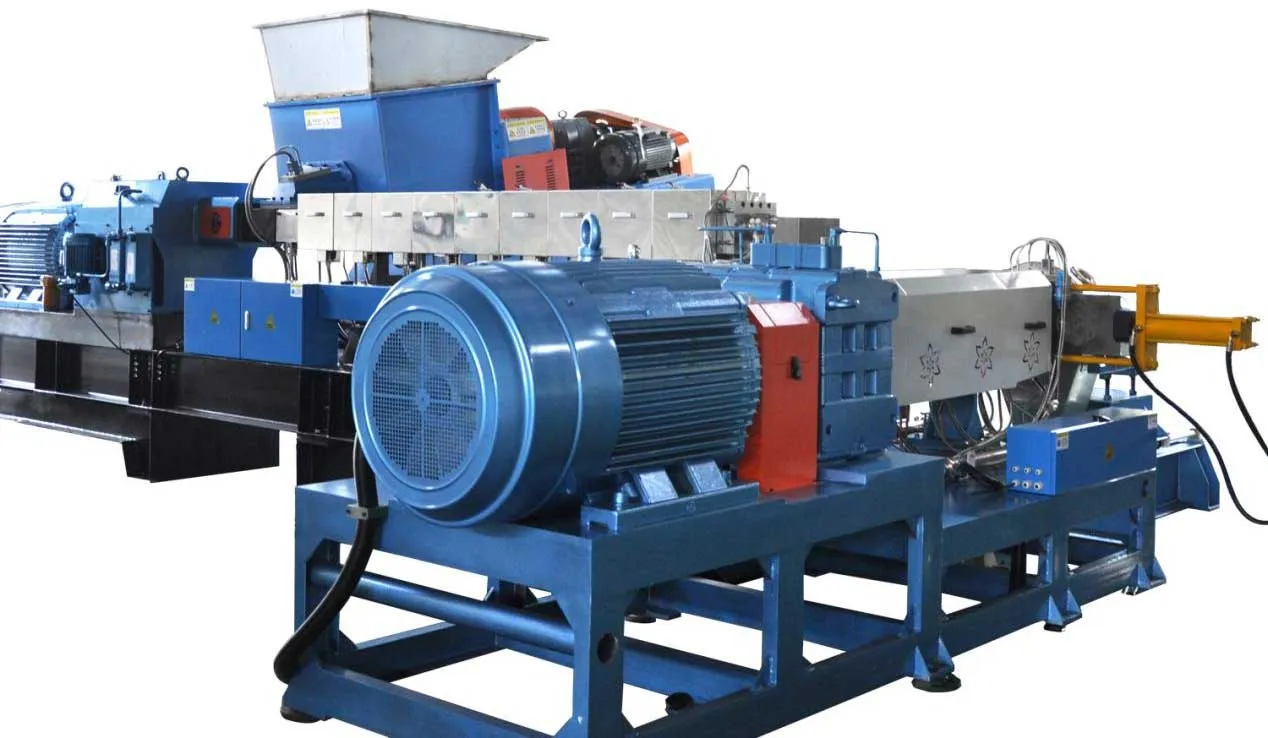
Key Applications & Processing Solutions
- High-Loading Filler Masterbatches (CaCO3 / Talc / Mineral Fillers)
The Challenge: High powder ratios create extreme wear and excessive friction heat in standard extruders.
The Solution: Stage 1 handles 70%+ powder dispersion; Stage 2 stabilizes temperatures to ensure non-foaming, high-density granules. Highly popular among plastic filler manufacturers in hot-climate regions.
- Heat-Sensitive PVC Compounds (Soft/Rigid PVC, Cable Materials, Medical Grade)
The Challenge: PVC decomposes easily under uncontrolled thermal and shear energy.
The Solution: Gentle conveyance in Stage 2 prevents degradation, resulting in crystal-clear medical PVC or high-performance cable sheathings.
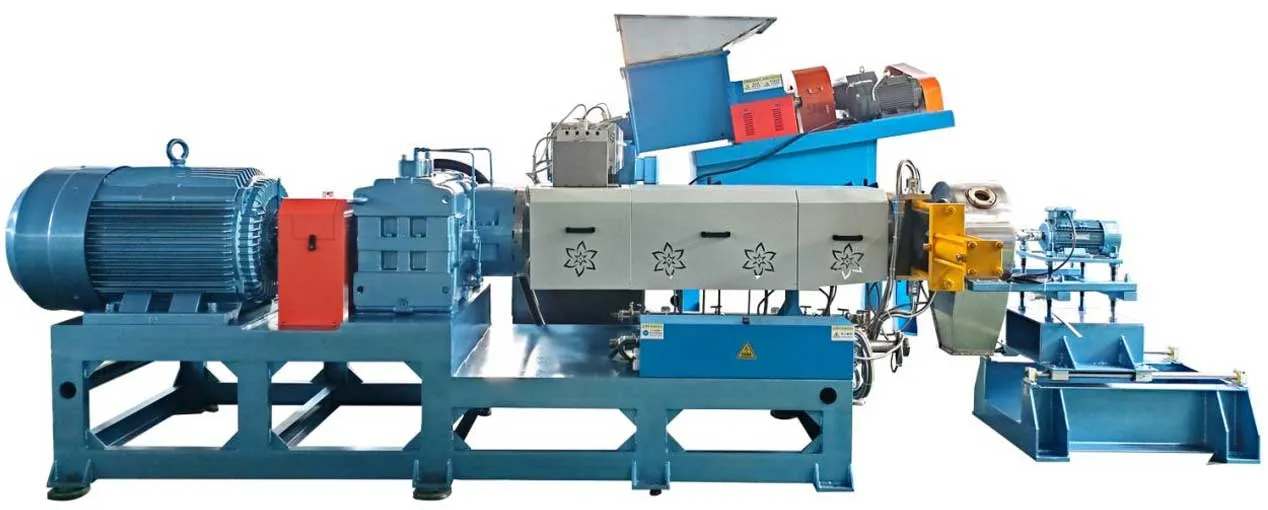
Optimized Pelletizing Solutions for Two-Stage Extruders
Unlike standard extruders that often use water-strand (spaghetti) pelletizing, Two-Stage Extruders are exclusively paired with Water-Ring Pelletizing or Air-Cooling Die-Face Cutting Systems.
Why Water-Strand Pelletizing Fails: High-filler masterbatches (70%+ CaCO3) lack the melt strength required to pull continuous strands through a water bath, leading to constant strand breakage. Similarly, PVC formulations are highly moisture- and thermal-sensitive.
Water-Ring Cutting (Best for PVC & Moderate Filler): Blades cut the melt immediately as it exits the die plate, followed by instant centrifugal drying. Produces uniform, dust-free spherical pellets.

Air-Cooling Hot Cutting (Best for Ultra-High Filler): Eliminates water entirely from the process, using air conveyance to cool dust-prone, high-calcium formulations cleanly.

Flexible Investment: One Main Extruder, Dual Interchangeable Pelletizing Systems
To maximize your return on investment and product versatility, our Two-Stage Extruders can be engineered with an Interchangeable Dual Pelletizing Setup.
How It Works: A single primary Two-Stage Extruder main engine equipped with quick-change flange connectors, paired with both a Water-Ring System and an Air-Cooling Hot Cutting System.
| Model | Diameter (mm) | Max. Speed (rpm) | L/D | Motor (kW) | Output (kg/hr) |
| SP50-120 | 50.5/120 | 500/85 | 24-48 | 37-45 | 200-300 |
| SP65-150 | 62.4/150 | 500/85 | 24-48 | 75/45 | 300-500 |
| SP75-180 | 71/180 | 500/85 | 24-48 | 110/55 | 300-800 |
| SP95-200 | 93/200 | 300/85 | 24-48 | 220/110 | 500-1000 |
Upstream Pre-mixing & Feeding Systems for High-Filler Masterbatches
For high-calcium (CaCO3) or talc filler masterbatch production, proper raw material pre-mixing is essential to ensure formulation homogeneity, prevent powder bridging, and maximize downstream extruder output. We offer three flexible pre-mixing configurations—available both as complete line integrations and as standalone auxiliary equipment—customized to your budget, space, and formulation requirements.

1.High-Speed Mixer (Compact & Cost-Effective)
Best For: Small-to-medium output lines, budget-conscious investments, or basic additive/powder coating.
Working Principle: High-RPM rotating blades generate friction heat, rapidly dispersing resins, fillers, and liquid additives (coupling agents/stearic acid) for surface coating.
Key Advantage: Small footprint, easy operation, and lowest initial capital investment.

2.High-Speed & Cooling Mixer Unit
Best For: Continuous, medium-to-large scale filler masterbatch and PVC compounding where moisture control and dry-powder flowability are critical.
Working Principle: Features a two-tier system. The top high-speed mixer performs hot compounding, followed by automated discharge into the bottom cooling mixer. The cooling jacket lowers material temperature to prevent caking and agglomeration.
Key Advantage: Delivers ultra-dry, free-flowing mixed stock directly into the extruder, significantly reducing feeding surge and increasing main extruder output.

3.Dispersion Kneader + Conical Twin-Screw Force Feeder
Best For: Formulations with ultra-high filler loadings (80%+ CaCO3/Talc) or difficult-to-disperse pigments and additives. Working Principle: The sealed dispersion kneader uses heavy-duty rotors under pneumatic pressure to force high-density powder into the polymer matrix. The compacted compound is then continuously pushed into the main extruder via a conical twin-screw force feeder. Key Advantage: Provides the highest shear and dispersive energy, completely overcoming powder feeding resistance for premium-grade, ultra-filled compounding.

How can we help you?
Send us email or fill in below contact form. We will reply your message as soon as possible.