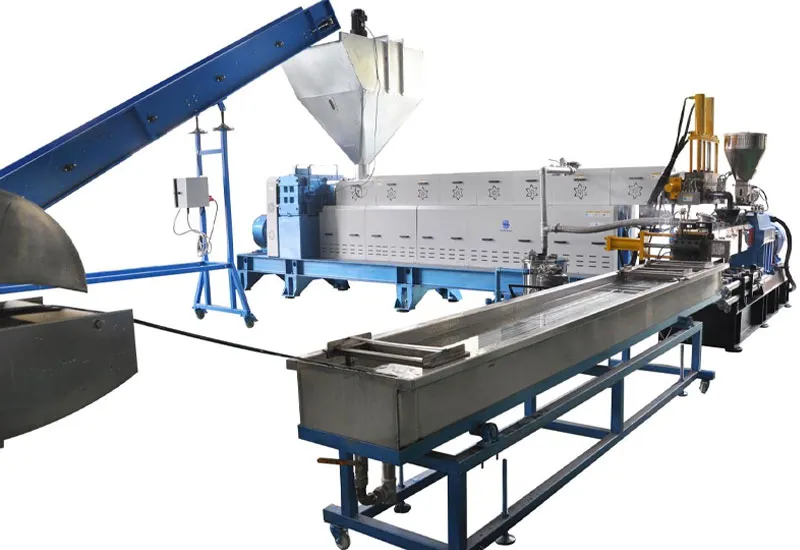
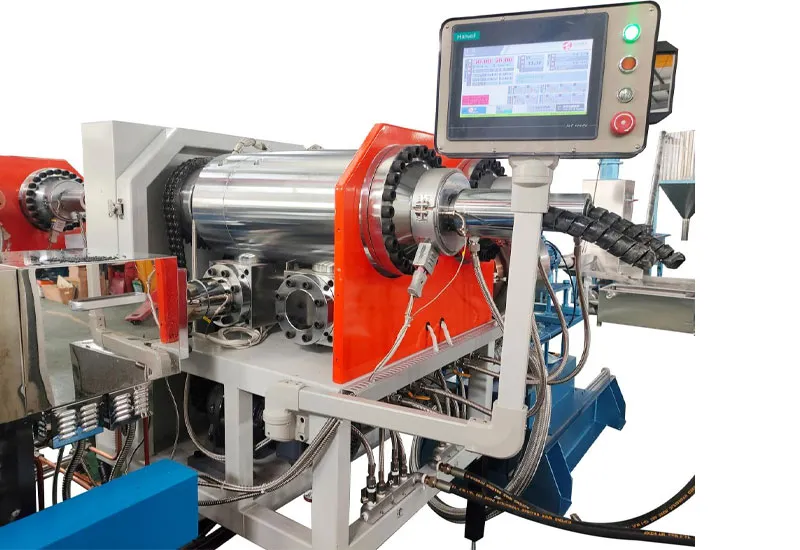
Plastic Recycling Line
Working Process
1. collection
2. sorting
3. crushing
4. washing
7. granulating
6. melting
5. drying
1. collection
2. sorting
3. crushing
4. washing
5. drying
6. melting
7. granulating
Collection and sorting are generally done manually
The material is fed into the crusher through a belt conveyor.
There are various types of waste plastics collected, with dust, sand, oil stains, etc. attached to the surface. These impurities seriously affect the quality of recycled plastics. Generally, these impurities are removed by increasing the frequency of crushing and cleaning, so as to improve the quality of recycled products
The hot air drying system is used to dry the material. The moisture content of the material after drying is 5%-8%.
Then extruded through an extruder, and finally the molten plastic is cut into uniform particles of appropriate size.
Wet granulation is a commonly used recycling granulation method, which has a simple process, low cost and a wide range of products.
Recommended Extrusion Systems for Different Plastic Recycling Needs
Single Screw Extruder (Single-Stage System)
· Best For: Clean, pre-washed, and low-moisture plastic waste (e.g., PP/PE film flakes, rigid HDPE regrinds).
· Key Features: Cost-effective, simple mechanical structure, low energy consumption, and easy daily operation/maintenance.
· Working Principle: Provides stable melting and basic filtration. Ideal for standard pelletizing where raw material purity is high and advanced degassing is not required.
Two-Stage Single Screw Extruder (Cascade System)
· Best For: Contaminated, highly printed, or high-moisture plastic waste (e.g., post-consumer PP/PE agricultural film, printed shopping bags).
· Key Features: Superior cooling in the second stage, higher production output, and stable continuous operation.
· Working Principle: The first single screw melts, filters, and removes most moisture and volatiles. The melt then feeds into the second, larger-diameter single screw for lower-temperature cooling, final degassing, and smooth extrusion without particle foaming or bubbles.
Twin Screw Extruder (Co-Rotating System)
· Best For: PET bottle flakes, ABS, TPU, PC, and engineering plastic recycling requiring high melt quality.
· Key Features: Superior mixing and dispersing capability, deep vacuum degassing via Roots pumps, self-wiping screw profile, and customizable die-head designs.
· Working Principle: Co-rotating twin screws provide excellent distributive and dispersive mixing, efficient volatile removal under high vacuum, and precise temperature control to maintain polymer molecular weight.
Single-to-Twin Tandem System (Single Screw + Twin Screw Line)
· Best For: Direct "Recycling + Compounding/Reinforcement" in a single heat history (e.g., converting dirty waste PP/PE/PET directly into glass-fiber reinforced or mineral-filled high-grade pellets).
· Key Features: One-step processing, protects polymer chains from thermal degradation, supports optional side feeders (for short glass fiber/CaCO3) and liquid injection systems (for additives).
· Working Principle: The primary single screw handles large-volume intake, melting, and primary filtration of recycled stock. The secondary twin screw receives the clean melt and performs intense mixing with additives or reinforcements, producing high-value modified engineering pellets directly from waste.
Line Capacity & Specification Scope
Our plastic recycling and pelletizing systems are specifically optimized for small-to-medium output requirements (approx. 100 kg/h to 800 kg/h). We focus on high flexibility, precise temperature control, and superior melt quality rather than ultra-large volume bulk processing ($>1,000\text{ kg/h}$).
*Note: Actual hourly output varies depending on raw material form (film, regrind, bottle flakes), bulk density, moisture content, melt flow index (MFI), and screen filter mesh size.
Customizable Modular Auxiliary Systems
Beyond complete recycling lines, we offer high-performance auxiliary equipment optimized for specific process stages. Every component—from material reduction to melt filtration—is engineered for continuous industrial operation. All listed auxiliaries are available as standalone units for those looking to upgrade existing extrusion lines or optimize specific stages of their recycling process.
Plastic Crusher vs. Plastic Shredder
Selecting the right size reduction equipment is critical for stabilizing downstream extrusion and optimizing line efficiency. While both machines break down plastic waste into smaller pieces, they operate on completely different mechanical principles and target distinct material forms.
*Plastic Shredder (Heavy-Duty & Bulk Materials)
- Working Principle:Utilizes low-speed, high-torque rotating shafts with heavy teeth to tear and shear large, thick, or tough plastic stock.
- Best For:Bulk, thick-walled, or high-rigidity waste, such as heavy plastic pallets, drums, large pipes, thick purgings, and densely baled materials.
- Key Advantages:Low speed prevents material overheating; handles metal/heavy impurities with lower risk of blade damage; produces less dust.
*Plastic Crusher (Thin-Walled & Fine Reduction)
- Working Principle:Operates at high speed with sharp, fast-rotating blades to slice material against stationary bed blades, producing uniform small flakes.
- Best For:Thin-walled or flexible plastic waste, such as hollow bottles, thermoformed trays, thin pipes, and pre-shredded material.
- Key Advantages: Delivers precise, uniform flake sizes ideal for direct feeding or washing; highly efficient for lightweight materials.
Roots vacuum pump, also known as mechanical booster pump, is a rotary positive displacement vacuum pump.
Product Features:
- High speed, high volumetric efficiency;
- Simple structure, convenient operation and maintenance; Fast start-up;
- Low noise, stable operation;
- Significant energy-saving effect and low fuel consumption.
Hydraulic automatic screenless filter is specially designed for the recycled plastic granulation industry, with the characteristics of automatic impurity removal, no filter, environmental protection and power saving, enhanced plasticization, no loss, and simple control.
The equipment is equipped with high-precision super wear-resistant alloy unidirectional filter plate hole, when working, the melt plastic passes through the fine hole, impurities and dirt remain on the inner wall of the filter hole plate, and the impurities are automatically removed by the impurity removal scraper regularly, and pushed to the impurity storage cavity through the impurity removal device.
It greatly improves the efficiency of the recycled plastic extruder and saves costs.
Laser Continuous Filtration System (Automatic Screenless Filter)
Designed for high-purity continuous recycling without manual screen changes. It automatically scrapes and discharges impurities into an impurity cavity without stopping production. By completely eliminating downtime and frequent filter replacement, this technology guarantees zero melt breakage, ensuring stable, uninterrupted extrusion and superior pellet consistency.
Recycled plastics have broad prospects, and many plastics can be granulated in production and life, such as waste food bags, water bottles, agricultural films, tubes, and various waste plastic products can be reprocessed to produce plastic raw materials, and then through special processes and formulas, used in the manufacture of machine parts, water pipes, agricultural machinery, packaging bags, cement bags; Can replace some wood products; It can be used to manufacture all kinds of plastic bags, barrels, basins and other plastic products and living utensils.
customer case

· Customer code:29
· Country:Russia
· Capacity:200 kg/h
· Pelletizing system:water ring pelletizing line
· Extruder:SJ-140/120 two stage single screw extruder
· Application:PP/PE film recycling machine

· Customer Code:4004
· Country:Nigeria
· Capacity:200kg/h
· Pelletizing System:water cooling strand pelletizing line
· Extruder:HMS 120-100
· Material:waste PP/PE plastic
How can we help you?
Send us email or fill in below contact form. We will reply your message as soon as possible.