PET recycling pelletizing is not simply a process of remelting waste material into pellets. It is a highly integrated engineering system in which material condition, process stability, and equipment selection are closely interrelated. For factories planning to build or upgrade a PET recycling line, understanding these relationships is often more important than comparing individual machines.

This article reviews the key technical considerations in PET recycling pelletizing, focusing on five critical areas that largely determine long-term production stability and product quality.
1. Raw Material Condition
PET recycling feedstock mainly comes from two sources: post-consumer bottle flakes and post-industrial scrap such as film, sheet trim, or edge waste. Although both are PET, their processing behavior differs significantly.
Bottle flakes typically contain contaminants such as labels, adhesives, residual liquids, and degradation products, resulting in higher and more variable moisture content and IV fluctuation. This places greater demands on washing efficiency, drying capacity, degassing, and filtration during extrusion. Post-industrial scrap is usually cleaner and more consistent, but often non-crystalline, making it prone to softening and sticking during heating and conveying.
In PET recycling, washing and size reduction are not minor preparatory steps. Insufficient washing leads directly to melt contamination and excessive filter load, while poor flake geometry or excessive fines negatively affect drying efficiency, feeding stability, and overall extrusion performance. Many downstream processing issues can ultimately be traced back to inadequate raw material preparation.

2. Crystallization System
The importance of crystallization in PET recycling is frequently underestimated. Amorphous or low-crystallinity PET enters the glass transition range quickly during heating, causing surface softening and agglomeration. This behavior complicates drying, conveying, feeding, and pelletizing.
A crystallization system does more than improve drying efficiency. Its primary function is to stabilize the physical state of the material, ensuring predictable thermal behavior before high-temperature processing. Properly crystallized PET exhibits reduced moisture absorption and lower stickiness at elevated temperatures, significantly widening the processing window for extrusion and pelletizing.
In professional PET processing facilities, crystallization systems are often considered part of overall material management and may serve multiple production lines, including recycling, sheet extrusion, and film production.
3. Extruder Selection
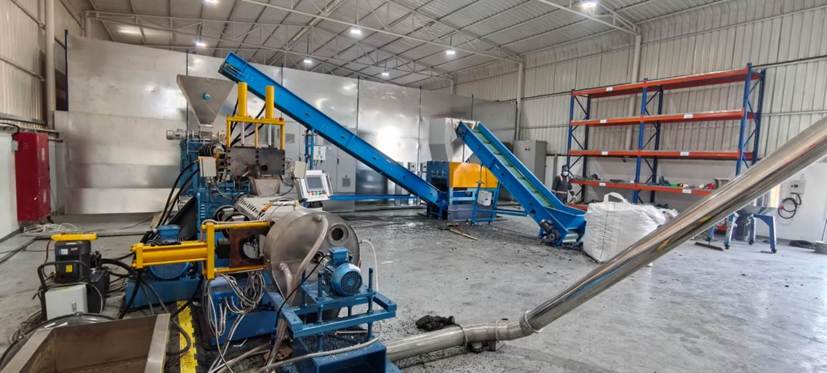
Twin-screw extruders are widely used in PET recycling not because of higher nominal output, but due to their superior adaptability to variable raw material conditions. The intensive mixing, melting, and homogenization capabilities of twin-screw designs allow for more stable melt quality despite fluctuations in moisture, contamination, or feedstock consistency.
In addition, multi-stage venting and vacuum degassing are more easily integrated into twin-screw systems, enabling more effective removal of moisture and low-molecular-weight volatiles—critical for maintaining PET molecular integrity.
Single-screw extruders can also be used in PET recycling when the feedstock is well crystallized, thoroughly dried, and consistent in quality. In such cases, they offer advantages in energy consumption and maintenance simplicity, provided that material conditioning is handled upstream.

4. Degassing System
In PET recycling pelletizing, the purpose of degassing is not merely to achieve high vacuum levels, but to remove moisture and volatile components efficiently and consistently at appropriate process stages. For feedstocks with higher or fluctuating moisture content, simple atmospheric or dual venting configurations may be insufficient at higher throughputs.
Roots vacuum pumps provide higher gas throughput at low absolute pressures, significantly improving devolatilization efficiency and process stability. Whether a Roots system is necessary should be determined based on raw material condition, target output, and quality requirements, rather than being treated as a standard or optional upgrade.

5. Pelletizing Method Selection
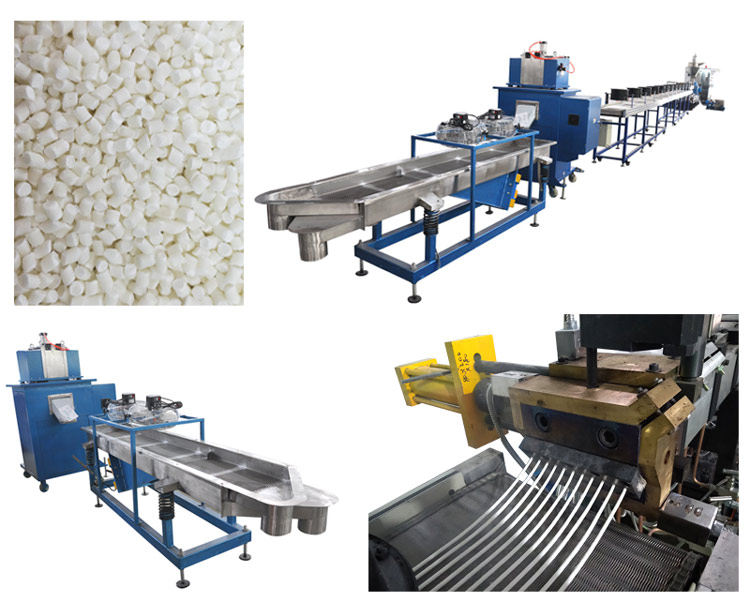
Strand pelletizing remains the most common method in PET recycling because of its robustness and wide processing window. Allowing the melt strands to partially solidify in air before water cooling reduces sensitivity to short-term viscosity and temperature fluctuations, which are typical in recycling applications.
From a technical standpoint, PET recycling can be combined with underwater pelletizing, but only under well-controlled conditions. Underwater systems require stable melt flow, sufficient crystallinity, and precise temperature control, making them better suited for high-capacity, well-established operations with consistent material quality.

Conclusion
There is no universal configuration for PET recycling pelletizing.
Raw material condition, crystallization, extrusion and degassing capability, and pelletizing method are highly interdependent. A mismatch in any of these areas can compromise the entire system.
In most PET recycling projects, selecting a stable and well-matched process concept delivers greater long-term value than adopting the most complex or advanced technology.