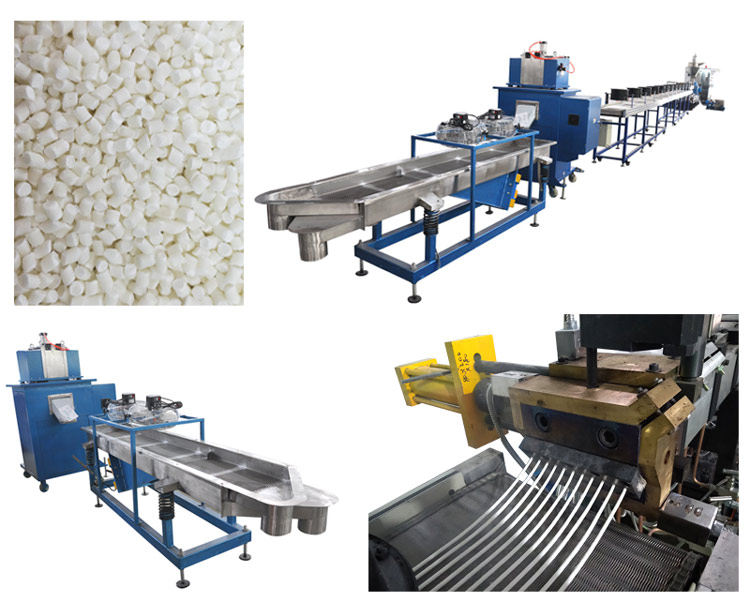
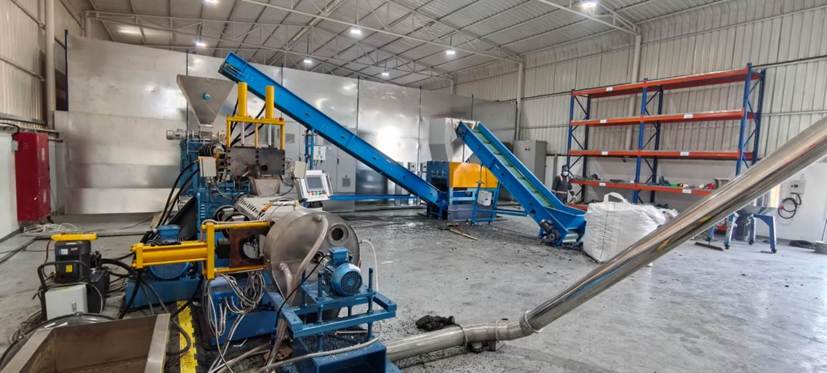
The counter-rotating twin screw extruder operates on a positive displacement principle, similar to a gear pump. Compared to a single screw extruder, it runs at lower speeds, generates less shear heat, and minimizes material degradation, making it ideal for processing thermally sensitive materials like PVC.

Counter Rotating Twin Screw Extruder
1. Transport Mechanism Differences
In a single screw extruder, material conveyance relies on drag flow—friction-driven for solids and viscous drag for melts. Transport efficiency depends heavily on the friction coefficient between the material and barrel and the melt viscosity.
In a counter-rotating twin screw extruder, materials are pushed forward by the intermeshing screws in a positive displacement manner. The tighter the screw engagement, the stronger the conveying efficiency. Fully intermeshing designs deliver maximum displacement.
2. Flow Dynamics & Performance Advantages
Single screw extruders have simpler, predictable flow patterns, while counter-rotating twin screw extruders feature complex flow interactions in the meshing zone. This enhances mixing uniformity, heat transfer, melting capacity, and venting performance.
Compared to co-rotating twin screw extruders, counter-rotating twin screw extruders offer superior conveying efficiency, better venting, and stronger melt homogenization. Although their dispersive mixing is slightly weaker, they excel at maintaining stable head pressure, making them ideal for direct extrusion (e.g., PVC pipes, profiles, sheets, and pelletizing).
3.Cost & Energy Efficiency Benefits
Replacing a single screw extruder with a counter-rotating twin screw extruder eliminates pre-plasticization and pelletizing steps, reducing PVC production costs. For example:
A 65/132 conical twin screw extruder (37 kW motor) can match the output of a 75–80 mm single screw extruder (90+ kW motor), cutting energy use by over 50%.
While parallel counter-rotating twin screw extruders are standard abroad for direct extrusion, China’s adoption of conical twin screw extruders for polyolefins (e.g., HDPE pipes) further lowers equipment costs without sacrificing performance.
Applications
Conical twin screw extruders: Traditionally used for PVC products, now expanding into polyolefins (e.g., energy-saving PE pipe production).
Parallel counter-rotating twin screw extruders: Gaining traction in large-scale HDPE pipe lines.
Why Choose Our PVC Pelletizing Equipment?
Kairong conical twin screw extruders and counter-rotating twin screw extruders deliver:
✅ Lower energy consumption vs. single screw extruders
✅ Gentle processing for heat-sensitive PVC
✅ Direct extrusion from powder, slashing production costs
✅ Stable output for pipes, profiles, and sheets
Contact us to optimize your PVC extrusion process with high-efficiency, cost-saving solutions!